
NASA’s state-of-the-art Nancy Grace Roman Area Telescope introduced this morning aboard a SpaceX Falcon Heavy rocket from Kennedy Area Middle in Florida, starting a million-mile adventure with the purpose of fixing one of the crucial many mysteries of darkish power and the origins of the Universe itself.
NASA’s new flagship area telescope will make the most of its 300-megapixel infrared Huge Box Device digicam along different tools to analyze darkish power and darkish topic, peer at exoplanets, find out about cosmic items in deep area, and, most significantly, chart a brand new direction for humanity’s figuring out of the Universe.
It is going to take Roman about 3 months to get to its ultimate vacation spot, Lagrange level two, or L2. From this orbital place, Roman’s number one medical instrument will probably be its 300-megapixel Huge-Box Device (WFI).

The digicam, which technically has 300.8 megapixels, options 18 particular person detectors, or symbol sensors, mixed to shape a large sensor. Each and every detector has 4,096 x 4,096 pixels, handing over a complete energetic pixel rely of over 300 million. The WFI is delicate throughout 0.5 to two.3-micron wavelengths.
The WFI’s declare to reputation is its fairly large box of view, overlaying 0.281 sq. levels. That is more or less 100 occasions the world coated by way of the Hubble Area Telescope’s Complicated Digital camera for Surveys or the NIRCam at the James Webb Area Telescope. Roman’s WFI covers about 200 occasions the world of Hubble’s Huge Box Digital camera 3.

“Roman pairs a big box of view with crisp infrared imaginative and prescient to discover huge swaths of the sky and probe deeply into cosmic historical past,” NASA explains. “This flagship project will lend a hand astronomers discover darkish topic, darkish power, and worlds outdoor of our sun gadget, referred to as exoplanets. Its surveys will improve a large vary of analysis extending a ways past the project’s major science targets.”
“Roman will probably be a discovery system that can convey us nearer than ever prior to to answering humanity’s maximum profound questions on our cosmic historical past,” explains Nicky Fox, affiliate administrator for the Science Challenge Directorate at NASA Headquarters in Washington, D.C.
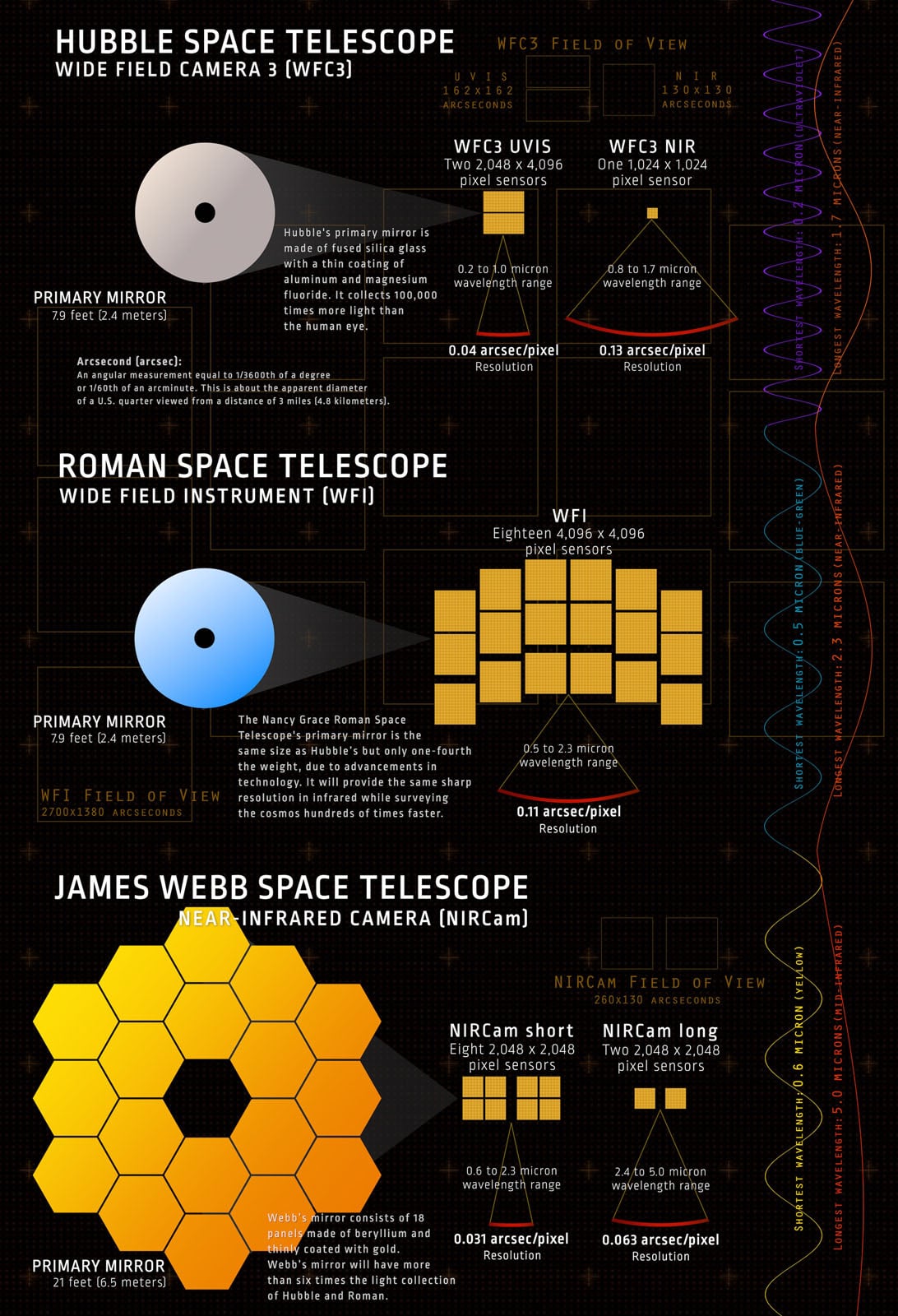
“With its massive box of view and speedy survey speeds, Roman will usher us into a brand new generation of discovery and make the invisible visual, atmosphere the basis for humanity’s seek for existence past our sun gadget,” Fox continues.
A couple of weeks from now, whilst Roman continues to be en path to its ultimate vacation spot one million miles clear of Earth, its Huge Box Device will activate. Each and every of its 18 4K detectors, each and every the scale of a saltine cracker, will stir up and scientists will start calibrating the whole lot. This procedure will take months, and NASA expects to submit Roman’s first photographs by way of early 2027.
As soon as the principle project is energetic, Roman will ship 1.4 terabytes of knowledge again to Earth each unmarried day, the easiest charge of any NASA astrophysics project in historical past.
“We’ve by no means been ready to view the universe with eyes like Roman’s prior to,” says Julie McEnery, Roman’s senior mission scientist at NASA Goddard. “There’s no telling what extra we’ll know and feature noticed by way of this time subsequent yr.”
Symbol creditNASA