
The Euclid area telescope found out one thing fantastic within the Milky Manner’s cosmic group, a impressive Einstein ring.
An Einstein ring is a impressive phenomenon in which the sunshine from a far off galaxy bends to shape a visual ring surrounding a foreground object. Gravity robotically impacts mild in area, and scientists ceaselessly depend on gravitational lensing right through observations. On the other hand, what makes an Einstein ring so particular and visually impressive is that once the far away mild supply, the lensing object, and the observer are in best possible alignment, the gravity-warped mild seems as an exquisite ring.
Gravitational lensing was once predicted by way of Einstein’s idea of common relativity, which is why the development stocks his namesake. On the other hand, it’s price noting that Einstein rings also are once in a while known as Einstein-Chwolson or Chwolson rings, named for Russian physicist Orest Chwolson, who particularly was once a number of the first to check gravitational lensing.
Because of gravitational lensing, particularly huge items, like galaxies or clusters of galaxies, can act like cosmic magnifying glasses, enabling telescopes like Euclid to look a lot more far away items than would differently be conceivable.

Euclid, an improbable new area telescope that greater than 2,000 scientists from 300 global institutes helped construct, started early trying out in area in September 2023. At the moment, Euclid Archive Scientist Bruno Altieri noticed a slight trace of an Einstein ring in early take a look at pictures.
“Even from that first remark, I may just see it, however after Euclid made extra observations of the world, shall we see an excellent Einstein ring,” Altieri explains. “For me, with a lifelong passion in gravitational lensing, that was once superb.”
From Euclid’s viewpoint at L2, just about one million miles from Earth (1.5 million kilometers), the Einstein ring encircles the elliptical galaxy NGC 6505. This elliptical galaxy is set 590 million light-years away, which isn’t just about so far as it sounds. As NASA describes it, NGC 6506 is “shut by way of” on a cosmic scale.

The hoop of sunshine hitting Euclid’s 600-megapixel wide-angle symbol sensor has traveled about 4.42 billion light-years, originating from a a lot more far away, very shiny galaxy. The supply galaxy has no longer been at once noticed but and doesn’t have a reputation.
“An Einstein ring is an instance of sturdy gravitational lensing,” says Conor O’Riordan, of the Max Planck Institute for Astrophysics, Germany, and lead creator of the primary medical paper inspecting the hoop. “All sturdy lenses are particular, as a result of they’re so uncommon, and so they’re extremely helpful scientifically. This one is especially particular, as it’s so on the subject of Earth and the alignment makes it very gorgeous.”
“I in finding it very intriguing that this ring was once noticed inside of a well known galaxy, which was once first found out in 1884,” provides Valeria Pettorino, ESA Euclid challenge scientist.
“The galaxy has been recognized to astronomers for a long time. And but this ring was once by no means noticed earlier than. This demonstrates how robust Euclid is, discovering new issues even in puts we concept we knew smartly. This discovery could be very encouraging for the way forward for the Euclid undertaking and demonstrates its incredible functions.”
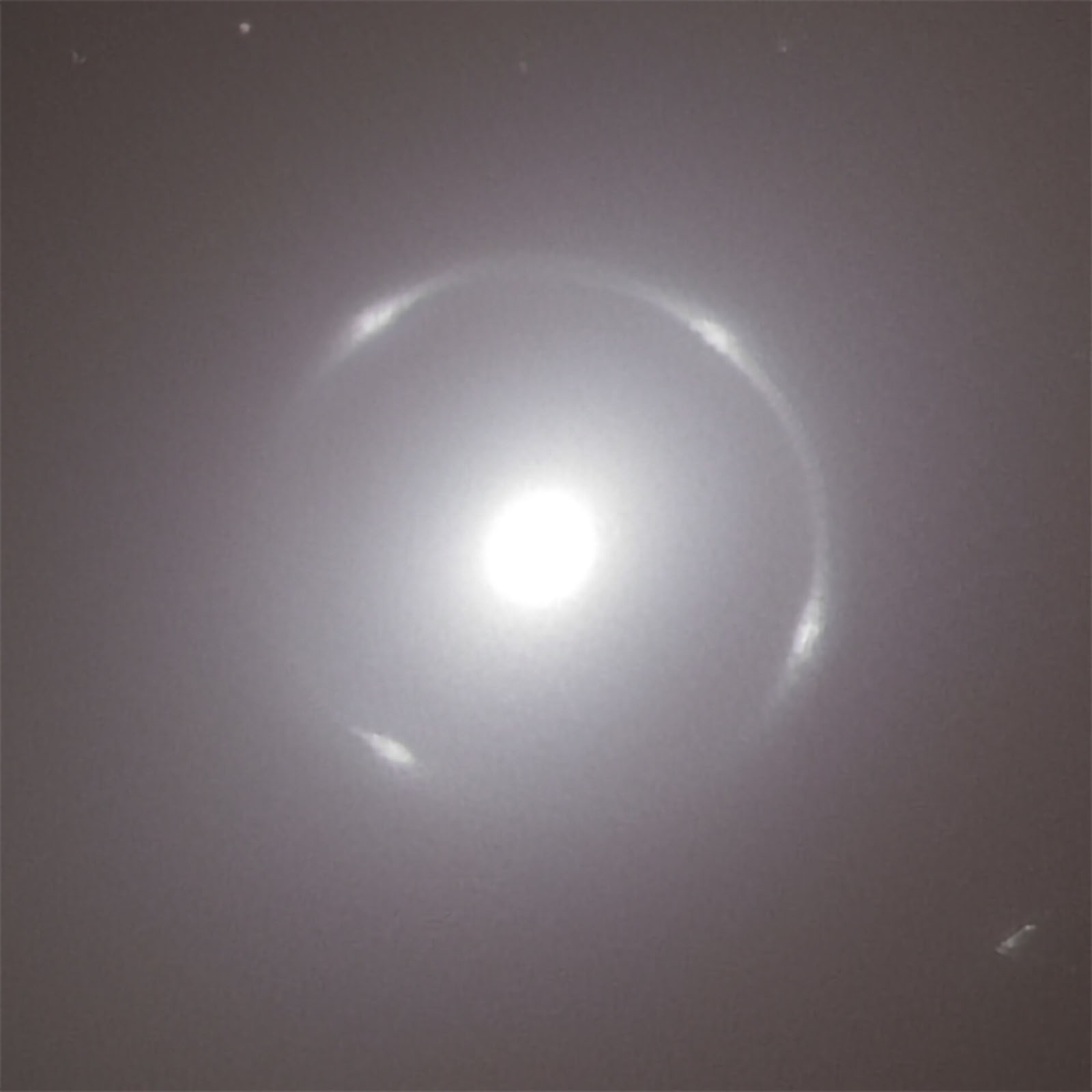
Euclid is designed to make stronger working out of gravity and the character of darkish power and darkish subject. Einstein rings are a very good approach for scientists to discover those subjects, as darkish subject contributes to how mild bends into a hoop.
Euclid will map greater than a 3rd of the sky right through its undertaking, staring at billions of galaxies as much as 10 billion light-years away. The crew expects to seek out round 100,000 sturdy gravitational lenses, even if it’s going to be tough to seek out one this gorgeous.
Symbol credit: ESA/Euclid/Euclid Consortium/NASA, symbol processing by way of J.-C. Cuillandre, G. Anselmi, T. Li; CC BY-SA 3.0 IGO or ESA Usual License