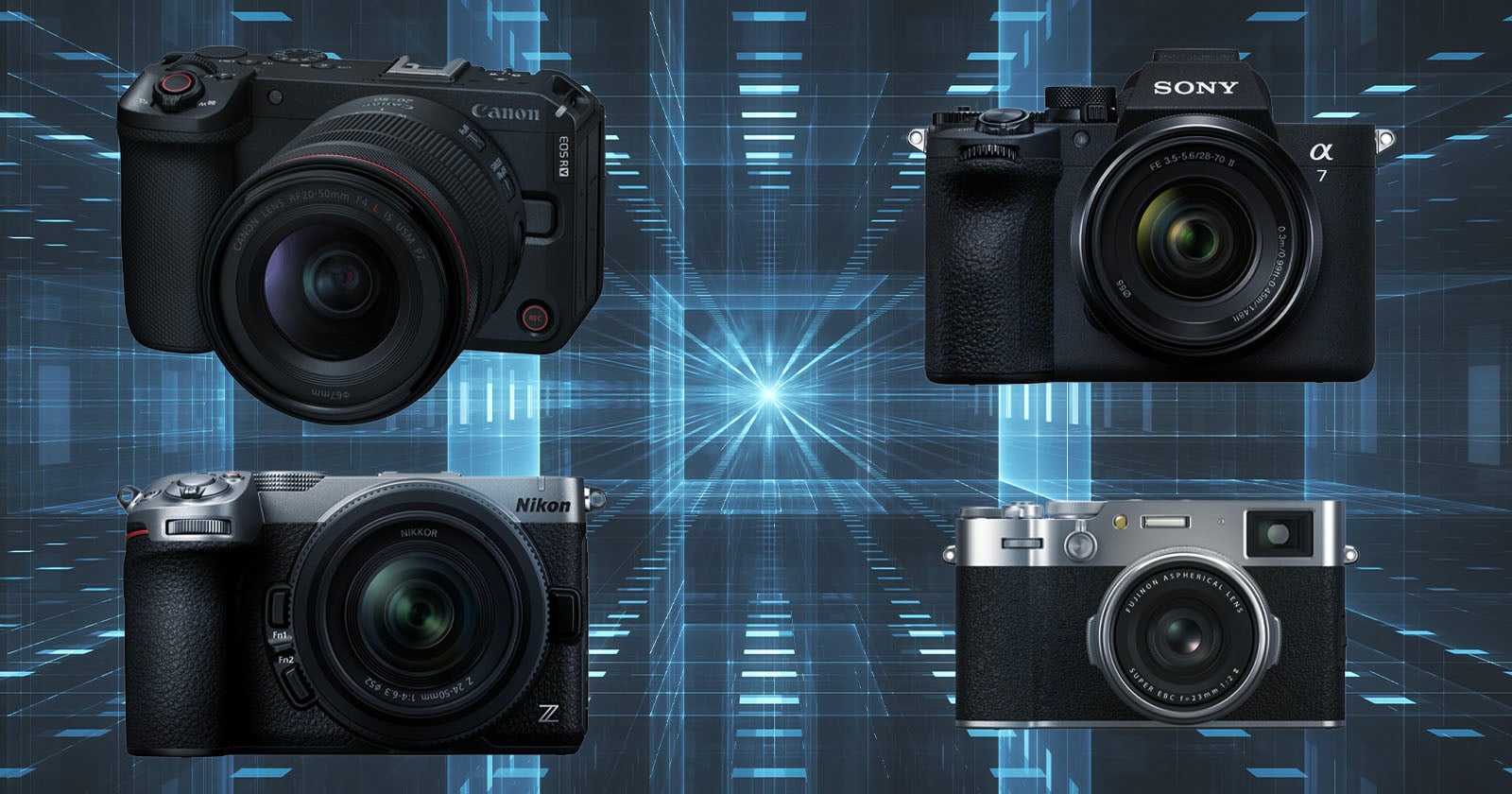
Closing month, Eastern newsletter Nikkei revealed a tale that featured interviews with executives from the highest digital camera makers: Canon, Nikon, Sony, and Fujifilm.
As noticed by means of Photograph Rumors, the tale was once revealed on Nikkei and contours a couple of names that could be acquainted to PetaPixel readers: Canon’s Pass Tokura, Nikon’s Hiroyuki Ikegami, Sony’s Kenji Tanaka, and Fujifilm’s Koji Matsumoto. All had been requested questions on their respective corporate’s imaginative and prescient for the long run, particularly with the lifestyles of AI, stepped forward video efficiency, and the copy of movie pictures seems to be and textures.
“Younger persons are using the present enlargement of compact virtual cameras. They no doubt aren’t purchasing them simply as a result of excessive efficiency or symbol high quality; they benefit from the capturing enjoy itself, although it comes with some minor inconveniences,” Canon’s Tokura says.
“Up till now, our lineup was once structured essentially round efficiency and value, however now we want to weave in components of favor and really feel [such as the shooting experience]. People have their very own distinctive sense of self they need to categorical, and various techniques of taking part in pictures are spreading throughout society.”
Talking of the extra speedy long run, Tokura says that Canon desires to proceed to amplify its video-oriented cameras.
“We need to amplify the video-oriented ‘V Sequence’ lineup in keeping with buyer call for. We additionally want to enrich our video-oriented lens variety additional. It’s a very powerful that lenses can seize each video and stills, making sure that lenses made for video can shoot stills with none problems.”
Nikon is of the same opinion with a few of Canon’s issues, however are taking a somewhat other way.
“It’s taking somewhat of time to cascade the options of our flagship Z9 all the way down to lower-end fashions. Finishing a lineup from high-end to low-end drops the typical promoting value. These days, we’re concentrating investments on next-generation symbol processing engines, sensors, and video cameras. We’re proper in the midst of laying the ones foundations,” Nikon’s Ikegami says.
“As smartphones change into increasingly more subtle, there’s a call for for devoted cameras as a ‘smartphone + 1’ instrument that preserves smartphone battery existence. We’re creating merchandise that more youthful demographics will need to select up.”
By way of comparability, Sony appears to be fascinated with focusing the industry solely otherwise. In particular, Tanaka sees “Spatial AI” as the way forward for its Alphas collection cameras.
“[Spatial AI] comes to shooting the bodily international the use of symbol sensors to create a virtual dual, in which we will make truth extra horny or simulate alternative ways of presenting it. That simulation is then became content material for other folks to enjoy again within the bodily international,” he explains.
“The time period originated from the concept AI will have to be used now not only for operational potency or exertions financial savings, however to amplify the arena of leisure. In the long run, we need to achieve some degree the place we will generate content material adapted optimally for every person. Spatial reputation and topic monitoring applied sciences can no doubt be leveraged. With Alpha, bodily house may also be reproduced digitally. To start with look, ‘Alpha’ seems to be a standalone digital camera industry, however its essence lies in developing price for creators and content material customers.”
Principally, Sony sees its Alpha department as part of its overarching leisure targets, now not as a standalone industry that props itself up via its personal tasks. Consequently, Sony sees “creators” as now not simply photographers and filmmakers.
“Someone who creates one thing and conjures up emotion is a writer. This contains now not best photographers and movie administrators, but in addition dancers, musicians, and athletes. We need to make the most of Spatial AI to reinforce and amplify their creativity.”
In the end, Fujifilm reiterated what it has mentioned to PetaPixel prior to now: pictures must be a laugh.
“The unfold of smartphones democratized pictures. Via social media, other folks advanced a extra discerning eye for pictures. The call for for cameras amongst individuals who care deeply about self-expression has grown, resulting in our sturdy efficiency. We deploy advertising methods that permit other folks to really feel the ‘pleasure of pictures’ that smartphones can’t ship by means of having them take a look at cameras hands-on at capturing occasions and retail shops,” he explains.
“This depends upon a basis of era cultivated over a few years. Discovering affection within the tactile, analog really feel of turning dials or taking part in the distinct colour tones of movie pictures is best conceivable because of our collected digital camera era… AI can generate photographs, however best people possess the subjective sense of feeling, ‘That is actual.’”
Symbol creditParts of header photograph authorized by way of Depositphotos.com.
Associate Disclosure PetaPixel articles might come with associate hyperlinks; we might earn a fee if you are going to buy via one.