
Glass Imaging’s spectacular GlassAI Neural symbol sign processing (ISP) era is closely featured within the brand-new Honor 600 smartphone, promising to strengthen the zoom images revel in at the fancy new telephone.
What Does Glass Imaging Do?
PetaPixel has coated Glass Imaging’s AI era a lot of occasions in the previous few years, together with a shuttle to Glass Imaging’s California headquarters in 2024. The corporate’s number one center of attention is the usage of AI era and extra clever symbol sign processing to dramatically strengthen symbol high quality from small symbol sensors and cell digicam programs.

By means of leveraging its refined algorithmic era, a selected imaging pipeline, and on-device processing energy, GlassAI can lend a hand smartphones triumph over the bodily boundaries of small sensors and lenses.
When it comes to the Honor 600, GlassAI applies its neural community processing to the telephone’s zoom imaging, “serving to to recuperate tremendous element, cut back noise, and keep herbal colour and texture around the zoom differ.”

GlassAI Throughout the Honor 600 Smartphone
”We’re venerated to spouse with Honor and to have our Neural ISP era featured within the 600 sequence,” says Ziv Attar, CEO of Glass Imaging. “Honor continues to set a excessive bar for cell imaging, and we’re proud to give a contribution to that have and show off our product out there.”
As Glass Imaging tells PetaPixel, its neural ISP era is especially useful when coping with small pixels.
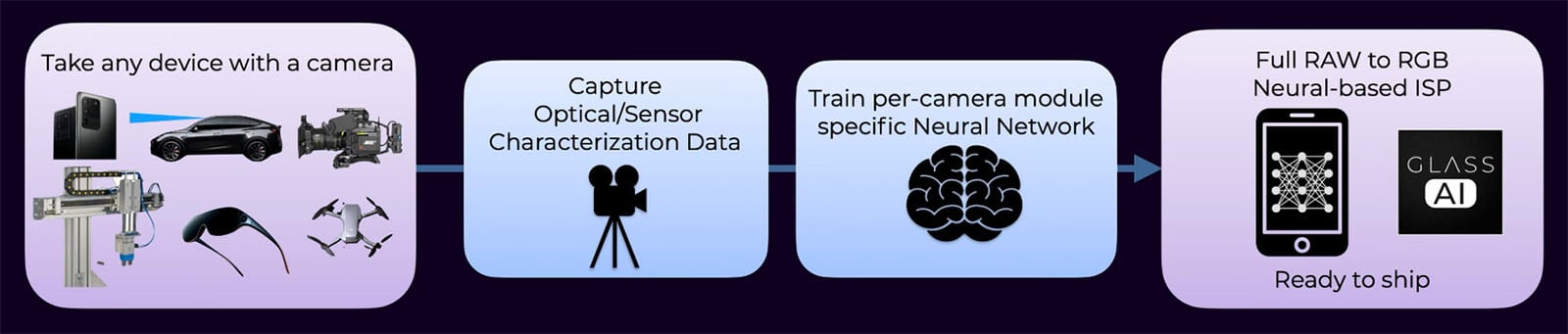
“On the whole, one merit we provide is in coping with small pixels. Sub-micron pixels encode high-frequency knowledge in advanced ways in which conventional ISPs fail to decode — that knowledge isn’t misplaced, simply arduous to recuperate. By means of modeling the precise level unfold serve as (PSF), sensor, and noise profile of every module, GlassAI corrects optical degradations at their supply as an alternative of depending on generic approximations,” Shivansh Rao from Glass Imaging’s system finding out workforce tells PetaPixel.



“In particular, smartphone cameras run into a difficult trade-off as pixels shrink: to stay diffraction in take a look at at tiny pixel sizes, designers have a tendency to widen the aperture, however a much wider aperture pulls in steeper rays on the fringe of the lens that introduce extra geometric aberration. A standard ISP does now not fashion the optics, so it could possibly’t undo that blur; it most often most effective smooths or sharpens round it. As a result of we fashion the true optics and sensor physics according to module, we proper the ones degradations immediately as an alternative of protecting them,” Rao continues.
As Glass Imaging has defined ahead of, the corporate plays in depth end-to-end coaching for demosaicing, denoising, deblurring, and multi-frame fusion concurrently, in order that some of these vital symbol processing steps are carried out in parallel somewhat than one after some other.
“A conventional ISP runs [these] as a sequence of discrete steps, and every step discards knowledge the later steps can by no means recuperate,” Rao says. “By means of coaching the entire pipeline end-to-end at the RAW, we steer clear of that compounding loss.”
Understandably, given the on occasion jarring, unrealistic, and unpleasant-looking effects from many conventional computational images fashions and modes, photographers are a little bit bit skeptical of anything else AI-related of their telephones. Glass Imaging hopes to steer clear of the pitfalls of extra conventional computational images through depending on an actual RAW symbol knowledge sign at each and every step of the method. The corporate’s fashion isn’t developing new element from skinny air, however somewhat convalescing “authentic element” from actual knowledge captured through the true symbol sensor.



“GlassAI Neural ISP is skilled to recuperate authentic element the optics in fact captured however an ordinary pipeline would lose, so the output remains real looking to what was once in entrance of the lens. That avoids the over-sharpened, synthetic, or ‘AI-cleaned’ glance you get when computational steps are guessing at element,” Rao says.
When it comes to the Honor 600, Glass Imaging’s era takes where of a devoted telephoto lens. Whilst many class-leading smartphones in this day and age characteristic 3 rear cameras, major, ultra-wide, and telephoto, extra mid-range fashions designed for purchasers on a tighter finances steadily eschew a devoted telephoto digicam. This may be the case for lots of very pricey folding or ultra-thin telephones, the place house is at a top class and a devoted telephoto digicam comes with too many different trade-offs.
So as an alternative of the usage of an extended lens with a devoted sensor, the Honor 600’s zoom serve as vegetation from its 200-megapixel major digicam.
“At the Honor 600, zoom isn’t treated through a devoted telephoto lens — the telephone reaches right into a scene through cropping its high-resolution major digicam. That places the burden at the sensor and major lens: the 200 MP major digicam makes use of a 16-in-1 ‘Hex Bayer’ trend, so its local pixels are tiny (round 0.56 μm) and most often binned into 2.24 μm super-pixels,” Rao says.



Overcoming the Bodily Boundaries of Small Pixels
“While you zoom, you’re successfully taking pictures at the ones local sub-micron pixels, which is strictly the place symbol high quality hits an actual physics downside.”
Whilst zooming in on a 200-megapixel sensor would possibly give you the knowledge for a good simulated telephoto shot, cropping like this additionally finds sensor-level problems, corresponding to diffraction and aberrations that may differently hurt symbol high quality. A blur spot may also quilt more than one pixels, for the reason that pixels themselves are so small.
“The result’s that merely including extra pixels stops serving to, a minimum of with naive polishing in a standard ISP, which is able to’t recuperate the misplaced element,” Rao tells PetaPixel.
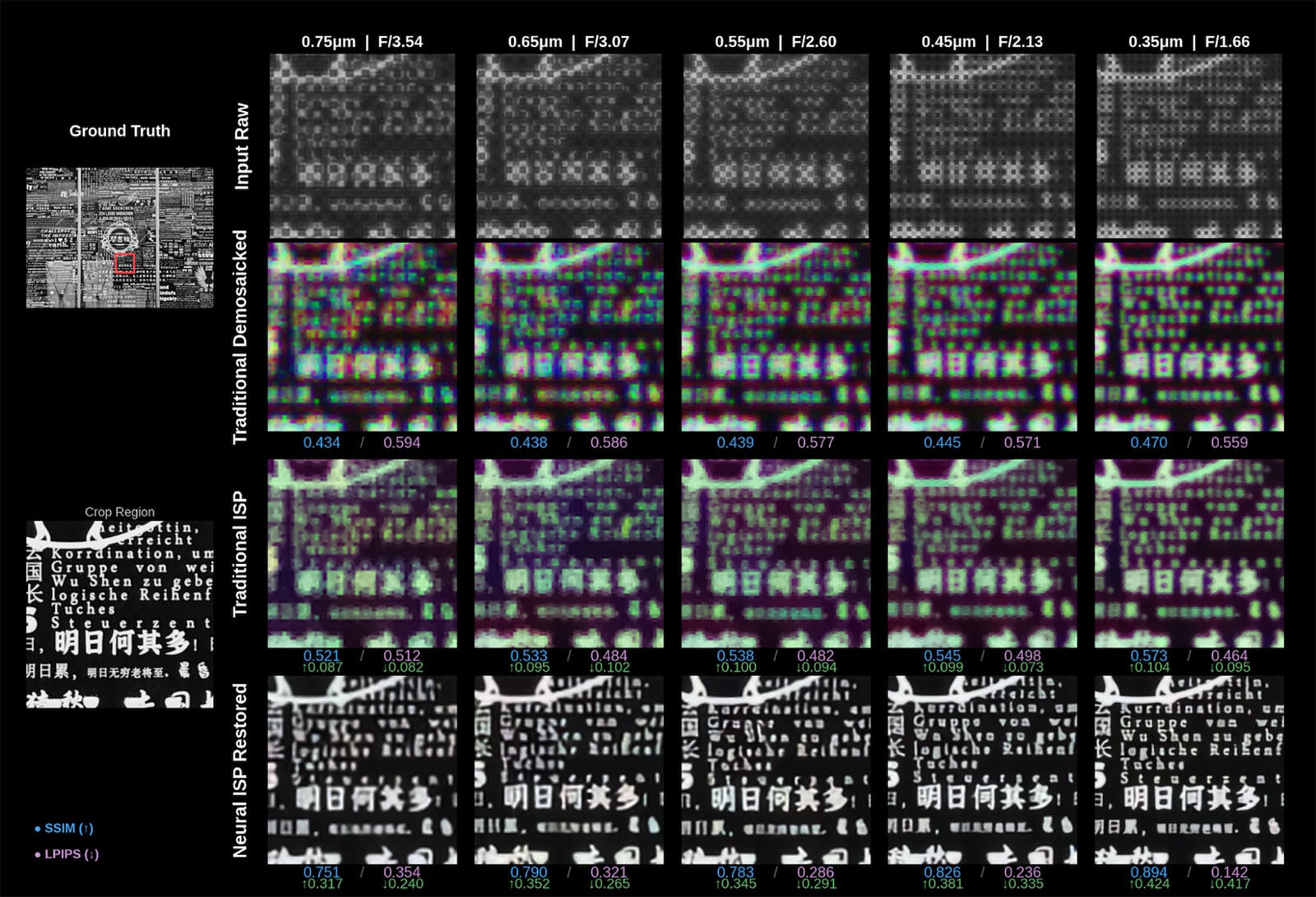
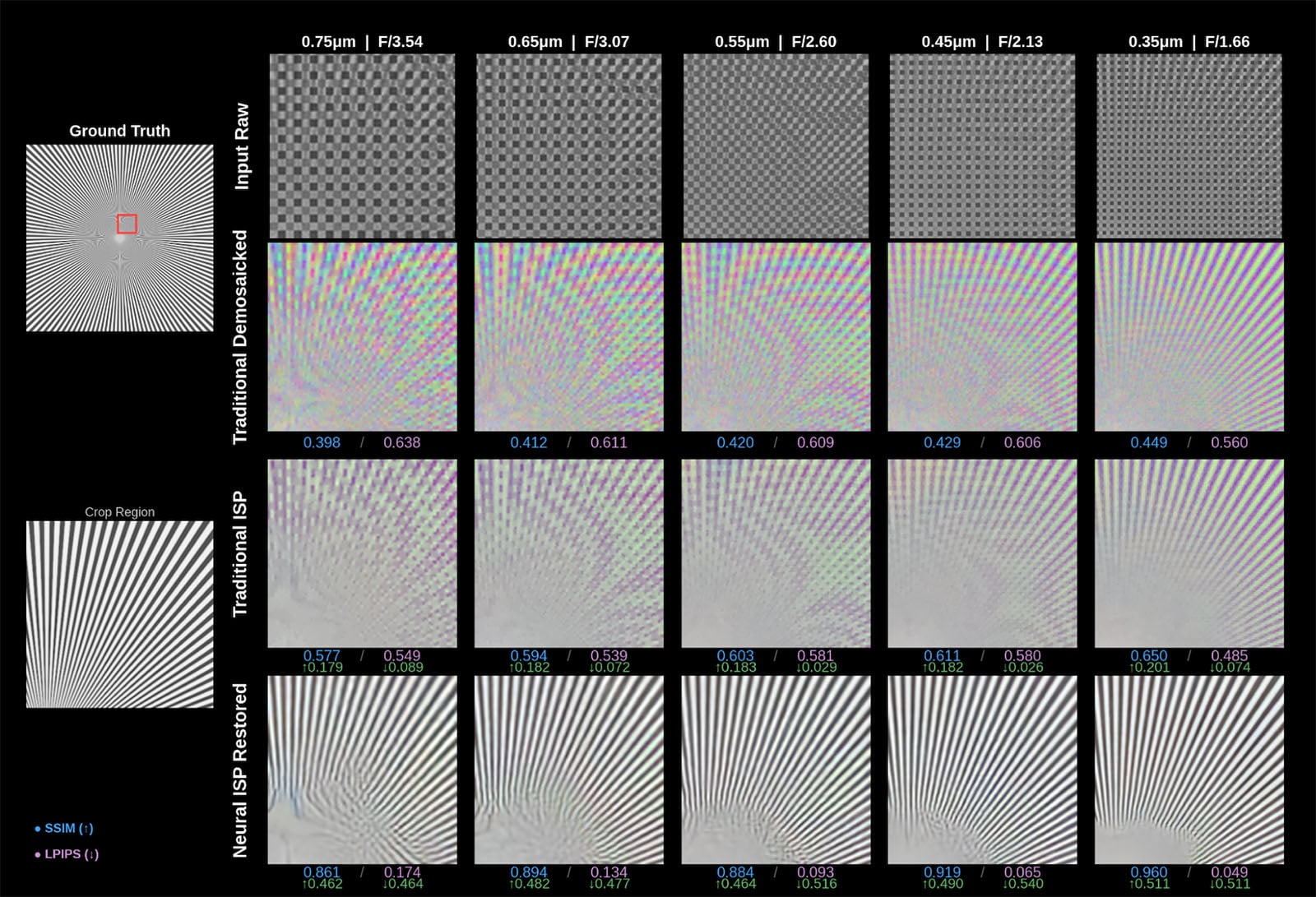
“GlassAI addresses this in two tactics. First, we incorporate lens aberration correction into the pipeline and teach on the true level unfold serve as (PSF), sensor, and noise of that exact module, which issues increasingly more as pixels shrink. In our personal managed learn about, neural recovery progressed decision (MTF50) through over 50% as pixels shrank from 0.75 to 0.35 μm (protecting the variability of the Honor 600’s sensor), whilst a standard ISP in large part stalled: because it has no fashion of the optics, the residual blur remains within the symbol and the additional element from denser sampling is misplaced,” Rao explains.
“That hole may be very arduous to near with a stepwise pipeline — by the point it sharpens, the actual element has already been discarded. 2nd, as discussed, we teach an end-to-end community at the RAW knowledge, keeping off the ideas losses of a standard multi-stage (demosaic, denoise, sharpen) ISP pipeline,” Rao continues.



Put otherwise, through exactly modeling all of the imaging pipeline, together with the precise sensor and lens used within the Honor 600’s 200-megapixel major digicam, Glass Imaging can recuperate main points that may normally be misplaced.
“We’re coming near what we name the ‘telephoto physics wall’: the purpose the place silicon scaling outpaces what typical optics and standard ISP can cleanly ship, and additional decision achieve is restricted,” the Glass Imaging Deep Optics workforce defined previous this 12 months in an especially detailed era article.
As the corporate presentations thru in depth trying out, its neural ISP considerably outperforms conventional symbol sign processing, turning in sharper, cleaner footage. The efficiency hole widens as pixel dimension decreases, opening new chances for smartphone producers.
Glass Imaging Can Make stronger Symbol High quality From Any Sensor
Talking of smartphone makers, whilst Glass Imaging can not talk about any specific long term, unannounced merchandise, Rao says the workforce is operating arduous to expand new applied sciences for lots of gadgets around the smartphone trade and past. Glass Imaging’s era provides promising advantages for any digicam, particularly the ones with smaller sensors and lenses, corresponding to wearables, drones, car, scientific, and extra.
“You will have to be expecting to look Glass Imaging in additional puts through the years,” Rao concludes.
Symbol credit: Honor 600 product footage through Honor. Actual-world pattern footage through Cyrus Tabar.