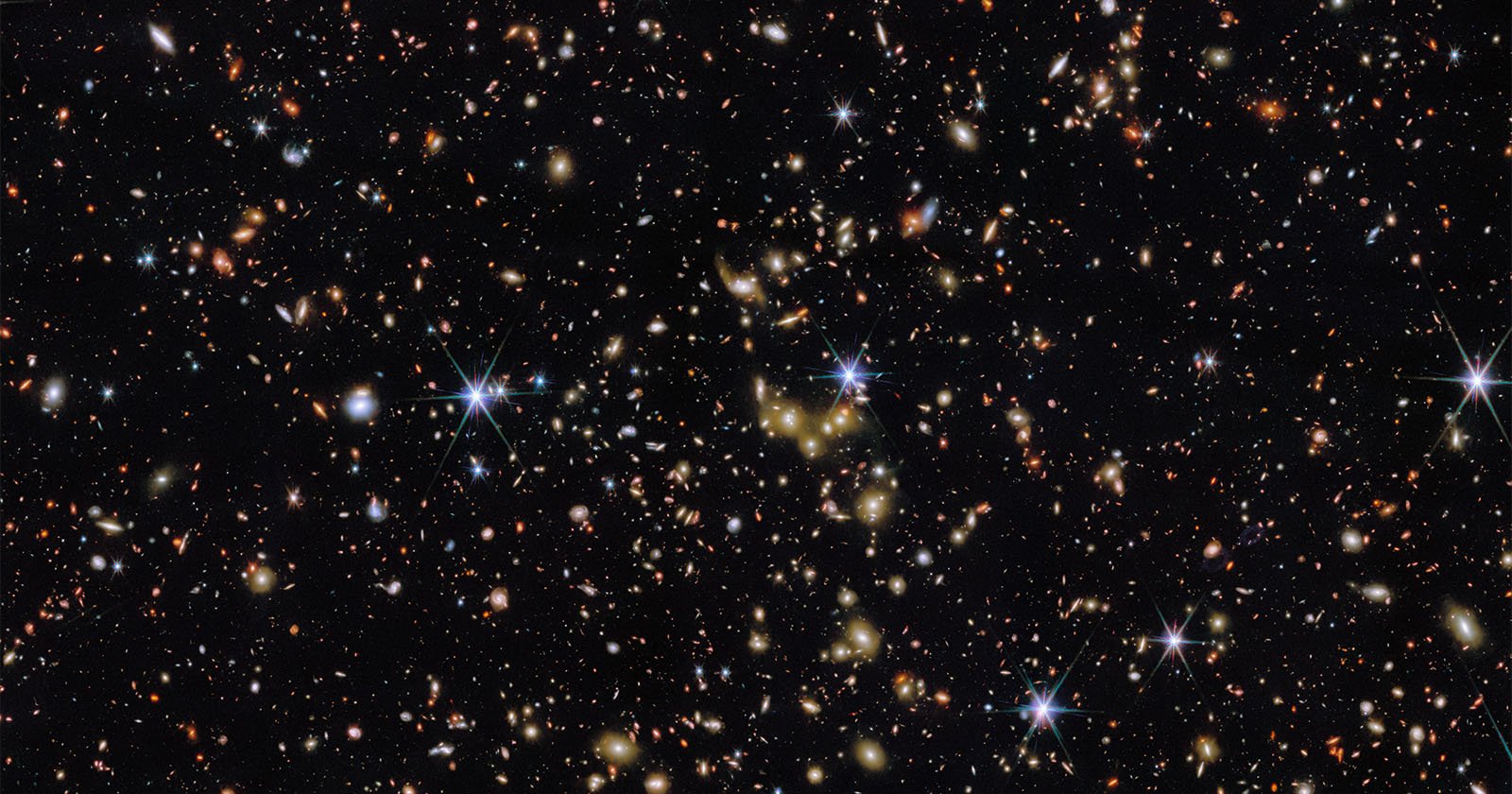
The newest James Webb House Telescope “Image of the Month” exemplifies the $10 billion telescope’s outstanding imaging features. The picture presentations cosmic gadgets starting from stars within the Milky Approach to galaxies billions of light-years away.
Inside of this one deep box picture are hundreds of galaxies, the biggest focus of which is visual close to the middle of Webb’s new symbol. The central cluster is an extremely attention-grabbing one since the galaxies “glow with white-gold mild,” because the Ecu House Company (ESA) explains.
“We see this galaxy team because it seemed when the Universe was once 6.5 billions years previous, rather less than part the Universe’s present age,” the ESA continues.
“This symbol gifts a visible dinner party of galaxies. Take a second to inspect the galactic buffet: you’ll see galaxies with refined spiral palms or warped disks, galaxies with clean, featureless faces, or even galaxies which can be interacting or merging and feature taken on an array of unusual shapes,” the ESA says.

As a snappy refresher, a galaxy’s — or any cosmic object’s — distance from Earth or an area telescope like Webb is measured in light-years. A gentle-year is the gap that mild travels in twelve months — or roughly 5.88 trillion miles (9.46 trillion kilometers). Now, take that nearly unimaginable distance and imagine that some mild in Webb’s new picture traveled for over seven billion years. Since Webb can seize such faint mild, it sees gadgets as they have been lengthy sooner than the Earth even shaped.
Whilst the James Webb House Telescope is a phenomenal technological success and its tools supply scientists with groundbreaking new information — and it takes stunning footage — it’s not the very best software for each astronomical activity. From time to time, different older telescopes have distinctive benefits that Webb doesn’t.

Webb’s newest shot seems to be on the maximum huge team in what scientists name the COSMOS-Internet box. COSMOS stands for “Cosmic Evolution Survey.” The survey is based upon a number of telescopes, together with Webb, the Hubble House Telescope, and the ESA’s XMM-Newton house observatory, which captures X-ray information.
Combining information of the COSMOS-Internet box captured by way of Webb, Hubble, XMM-Newton, and the NASA Chandra X-ray observatory, scientists created a composite that presentations deep house throughout many alternative wavelengths of sunshine. The X-ray information, proven in red, presentations sizzling gasoline within the galaxy team that will in a different way be invisible.

Red isn’t the one noteworthy colour in both model of the brand new picture. The other colours of galaxies and stars replicate various ages. More youthful stars are bluer, whilst older ones are redder. As for galaxies, the redder it’s, the extra far-off.
Via COSMOS-Internet, scientists hope to spot galaxies that shaped all the way through the epoch of reionization, be told extra about how the Universe’s maximum huge galaxies shaped, and perceive extra in regards to the dating between the mass of a galaxy’s stars and its prolonged galactic halo.
Symbol credit: ESA/Webb, NASA & CSA, G. Gozaliasl, A. Koekemoer, M. Franco, and the COSMOS-Internet group